How Much Hair Do I Need for Extensions? Density, Length, and Fullness
The amount of extension hair you need depends on your natural density, current length, haircut, texture, and whether you want more fullness, more length, or both. There is no universal number of strands, packs, or grams because the right amount must be customized to your natural hair and desired result.
Many people search for a specific number of grams, bundles, packs, or strands, but those measurements only become meaningful after the natural hair, desired length, and fullness goals are evaluated.
In this guide, Bloom Studio Hair Extensions explains how density, length, strand size, placement, and overall hair quantity shape a balanced, natural-looking installation.
The right amount is not the greatest amount possible. It is the amount that creates a seamless blend, natural movement, and comfortable everyday wear.
At our Houston studio, we do not begin with a standard package or another client’s strand count. We begin with your natural hair and the change you want to see.
Some clients need carefully placed strands to fill thinner sides or transparent ends. Others need a more complete installation to add significant length while maintaining fullness through the new ends.
What Determines How Much Extension Hair You Need?
Five factors have the greatest influence on the amount of extension hair we recommend:
- Your natural hair density
- Your current length and haircut
- Whether you want fullness, length, or both
- Your natural texture and strand thickness
- The condition of the areas that will support the extensions
Two clients may request the same finished length but need very different installation plans.
One client may begin with fine, softly layered hair and want subtle fullness. Another may have thick, blunt hair and want a significant increase in length. The second client may need more extension hair simply to continue her natural density through the longer ends.
This is why online charts, standard package recommendations, and another client’s installation can provide general context but cannot determine the right plan for your hair.
Do You Need More Hair for Length or Fullness?
Adding significant length usually requires more extension hair than adding fullness close to your current length.
When the goal is volume, the extensions may be concentrated in areas where the natural hair needs additional density, including:
- Thin or transparent ends
- Short sides
- Face-framing areas
- An uneven perimeter
- Areas that make the ponytail feel less full
The extension hair can often be blended close to the client’s current length, creating a fuller shape without a major length change.
When the goal is length, the extension hair must perform two jobs: continue below the natural ends and maintain enough density through the new length to look believable.
If too little hair is used for a dramatic length change, the natural hair may look full near the top while the extended ends appear thin or disconnected.
Clients who are happy with their current length can read our guide to adding volume without significant length.
These are general planning approaches. The final installation should always be based on the client’s own hair.
Why Does Natural Hair Density Matter?
Extension density should be compatible with the client’s natural density.
Fine hair often requires smaller individual strands, lightweight bonds, careful spacing, and a realistic finished length. The goal is to create a noticeable improvement without making the installation unnecessarily heavy or difficult to conceal.
Thick hair presents a different challenge. A small amount of extension hair may disappear beneath the natural hair near the roots but look too thin below the natural perimeter. Additional density may be needed to continue the client’s existing fullness through the added length.
During a consultation, our team assesses:
- Overall density
- Density through the sides and temples
- Individual strand thickness
- Areas of breakage or transparency
- The strength of the hair near the roots
- The amount of natural hair available to conceal the bonds
- The shape and fullness of the existing haircut
A client may have many fine strands and still have high overall density. Another may have thicker individual strands but less hair around the sides. These differences affect both the amount of extension hair and where it should be placed.
How Does Your Haircut Affect the Amount of Hair You Need?
Your haircut can significantly change how much extension hair is needed. Short, blunt, or uneven ends usually require more detailed density planning than longer, softly layered hair.
Soft layers often transition more easily into extensions because the natural ends already create a gradual shape. A thick, blunt haircut may require additional extension density and detailed blending to avoid a visible line between the natural hair and the extensions.
The greater the distance between the natural ends and the desired length, the more carefully the new density must be built.
We consider:
- Whether the perimeter is blunt or layered
- How full the natural ends are
- Whether the sides are shorter than the back
- Whether there is breakage around the face
- How much length the client wants to add
- How the client normally styles her hair
For example, a client with shoulder-length, blunt hair may need a more complete installation to reach a long finished length. A client with longer, softly layered hair may achieve a seamless result with a more conservative plan.
Before deciding how much hair is needed, it helps to choose a realistic finished length. Our hair extension length guide explains how different extension lengths may look depending on the client’s starting point.
Does Hair Texture Change the Amount You Need?
Yes. Texture affects both visual fullness and how naturally the extensions blend.
Wavy or curly hair may appear fuller because the texture creates more width and movement. Very straight hair can reveal differences in density more clearly, especially through the ends.
The extension texture should also work with the client’s normal styling routine. An installation should not look natural only after a professional salon finishes. It should continue to blend when the client wears her hair the way she normally does.
During planning, we consider:
- The natural texture when air-dried
- The texture after regular styling
- The diameter of the natural strands
- How much volume the hair naturally creates
- Whether the client usually wears the hair straight, curled, or wavy
- How the natural and extension hair respond to Houston humidity
A strong texture match can create a fuller, more seamless appearance without adding hair that does not improve the overall result.
How Do Individual Ice Fusion Strands Work?
Ice Fusion is a strand-by-strand method, allowing the installation to be customized across different areas of the head.
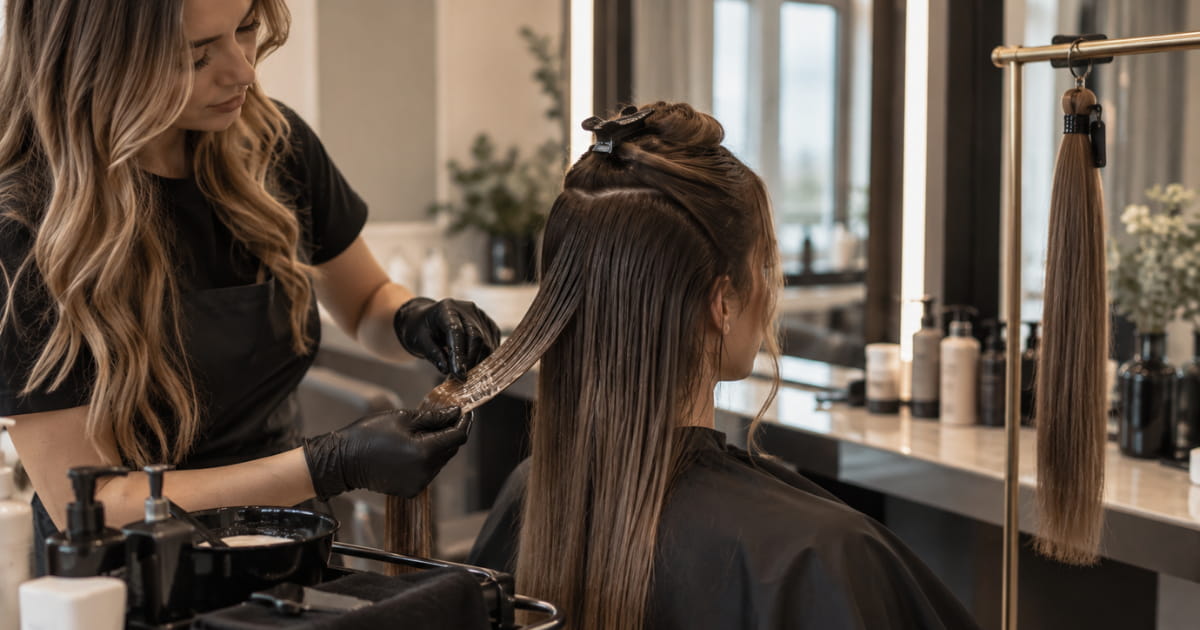
Ice Fusion Hair Extensions are applied strand by strand using a special cold gel or adhesive, without heat. Each small bond can be sized and positioned according to the client’s natural density, color, haircut, and desired result.
The back of the head may support more fullness, while the sides may need smaller strands and more conservative placement. Delicate areas around the temples, part, crown, or hairline may require fewer attachments or may need to remain free of bonds.
When planning Ice Fusion Hair Extensions in Houston, we consider:
- The number and size of the individual strands
- The size and color of the bonds
- The spacing between attachments
- The areas where added fullness will have the greatest impact
- The natural hair available to support and conceal each bond
For this reason, two installations with a similar strand count can still look and feel very different.
Do Extension Grams Matter?
Grams can provide a general measurement of the total amount of extension hair, but they do not explain how that hair will be divided into individual strands or distributed across the head.
Two installations with the same total weight may look and feel different depending on:
- The size of each extension strand
- The number of attachment points
- The client’s natural density
- The desired finished length
- The areas where the strands are placed
- The fullness needed through the sides and ends
This is why questions such as “Is 100g enough?” or “Do I need 150g?” cannot be answered accurately without knowing the extension method, starting density, strand size, haircut, and desired result.
For a customized Ice Fusion installation, total hair quantity is only one part of the plan. Strand size and placement are equally important.
How Many Packs or Bundles Do You Need?
There is no universal answer because packs and bundles are packaging terms, not personalized installation plans.
Different suppliers may package different numbers of strands, lengths, shades, or strand sizes. One pack may not contain the same amount of usable hair as another.
For an Ice Fusion installation, the more useful questions are:
- How many individual strands are appropriate?
- How large should each strand be?
- Where should the strands be placed?
- How much fullness is needed through the sides and ends?
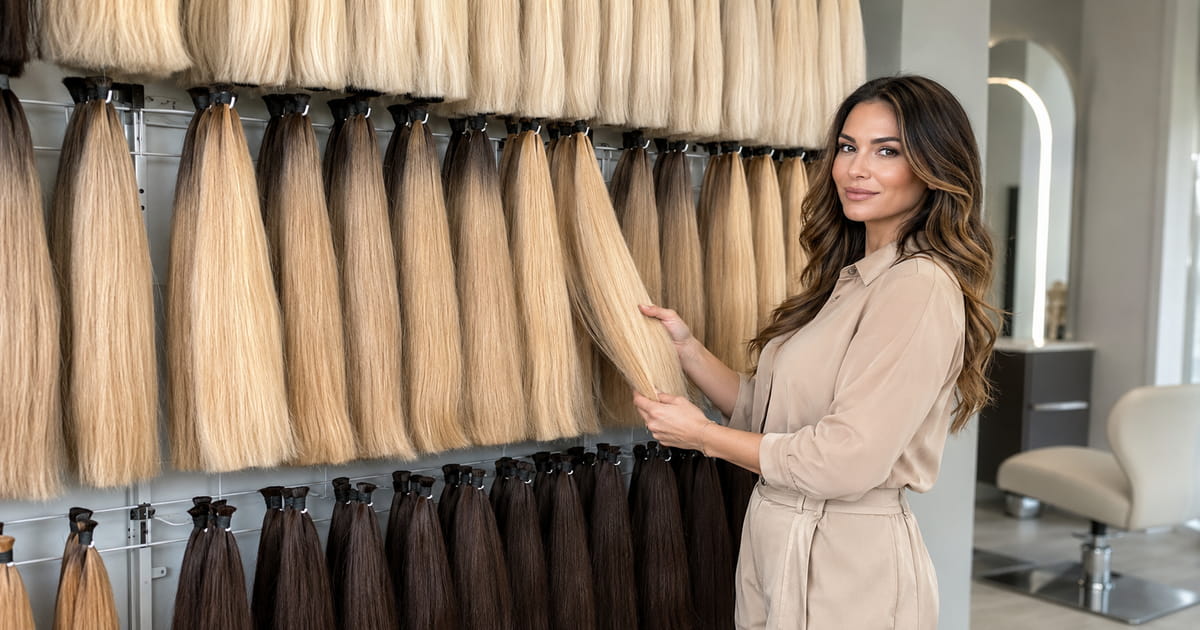
- How many shades are needed for a natural color match?
Package count may be part of ordering the hair, but it does not determine the final installation by itself.
Is More Extension Hair Always Better?
No. More extension hair does not automatically create a more luxurious or natural-looking result.
Too much hair can:
- Make the ends look disproportionately heavy
- Create too much contrast between the roots and perimeter
- Make bonds more difficult to conceal
- Make ponytails and updos feel bulky
- Increase washing, drying, and styling time
- Add maintenance without improving the finished shape
At the same time, a carefully planned amount of extension hair can create a meaningful difference without a dramatic increase in length.
Strategic placement may help fill transparent ends, improve density through the sides, strengthen an uneven perimeter, or make a ponytail look fuller.
Placement often matters as much as quantity.
A smaller number of strands positioned where the natural silhouette needs support may create more visible improvement than a larger number distributed without a clear plan.
How Much Extension Hair Does Fine or Thin Hair Need?
Fine or thin hair requires a conservative, customized plan. It does not automatically mean using the smallest possible number of strands.
Too few strands may not provide enough fullness to achieve the desired result. Too many—or strands that are too large—may feel heavy, become difficult to conceal, or be inappropriate for delicate areas.
For many fine-hair clients, a balanced result depends on:
- Small, lightweight bonds
- Customized individual strands
- A realistic finished length
- Strategic placement through the sides and ends
- Careful spacing between attachments
- Precise color matching
- Timely professional maintenance
Ice Fusion Hair Extensions can be a strong option for some fine- or thin-hair clients when strand size, bond size, placement, and finished length are professionally customized. Suitability should be confirmed during consultation.
Read our guide to hair extensions for fine, thin hair for more information about density, placement, and realistic expectations.
How We Determine the Right Amount of Hair
We begin with the finished result rather than a predetermined pack, gram amount, or strand count.
During your consultation, we:
- Clarify whether you want fullness, length, or both.
- Evaluate your natural density, strand strength, haircut, and hair condition.
- Consider how much added weight may be appropriate for different areas of the head.
- Select a realistic finished length.
- Match the extension color and texture to your natural hair.
- Create a customized placement plan.
If the desired transformation would require more density or length than the natural hair can appropriately support, we may recommend a more conservative approach.
The finished installation is not simply a number. It is a personalized combination of strand size, bond size, color, spacing, placement, and overall hair quantity.
Can the Amount of Hair Be Estimated From a Photo?
A clear photo can help us understand your current length, color, haircut, and general goal. It may also help us prepare for your consultation.
However, a photograph may not show:
- Fine areas around the temples
- Breakage beneath the top layer
- Differences in density across the head
- Individual strand strength
- Scalp sensitivity
- The true thickness of a blunt perimeter
Photos are useful for an initial conversation, but an in-person consultation provides the most reliable information for the final installation plan and quote.
What Makes Hair Extensions Look Natural?
Natural-looking extensions are created through proportion—not through the greatest possible number of strands.
The density through the ends should make sense next to the density at the roots. The selected length should have enough fullness to create a continuous silhouette. The bonds should be appropriately sized and positioned, while the color and texture should blend when the hair moves.
A natural-looking result depends on:
- Appropriate extension density
- A realistic finished length
- Customized strand and bond sizes
- Precise placement
- Accurate color matching
- Compatible texture
- Professional blending
- Consistent home care
Start With a Personalized Extension Plan
The most reliable answer to “How much hair do I need for extensions?” comes from evaluating your own hair—not copying another client’s strand count, gram amount, or package order.
Bloom Studio Hair Extensions specializes in personalized Ice Fusion Hair Extensions for clients who want natural-looking volume, length, or both. Our Houston studio is located near the Galleria and Uptown Houston.
During your hair extension consultation in Houston, our team will evaluate your natural density, discuss your preferred length and fullness, match your color and texture, and create an installation plan designed specifically for your hair.
Frequently Asked Questions
How many individual hair extension strands do I need?
There is no universal strand count for every client. The right number depends on your natural density, current length, haircut, desired fullness, strand size, and where the extension hair will be placed.
Do I need more extensions for length or volume?
Adding significant length usually requires more extension hair than adding volume near your current length. Longer transformations need enough density below the natural ends to maintain a balanced, natural-looking perimeter.
Do extension grams determine how much hair I need?
No. Grams measure the total amount of extension hair but do not show how that hair will be divided into strands or placed across the head. Natural density, strand size, placement, and finished length are also important.
Does thick natural hair require more extension hair?
It often can. Thick or blunt natural hair may require additional extension density so the new length does not look thinner than the hair near the roots.
Can fine hair support a complete extension installation?
Some fine-hair clients may be suitable candidates, but the installation must be customized. Small bonds, lightweight strands, conservative placement, and a realistic finished length are especially important.
How many packs or bundles of extensions do I need?
Pack or bundle count alone is not enough to plan an Ice Fusion installation because packaging varies. The number and size of individual strands, color combination, placement, and desired result are more important.