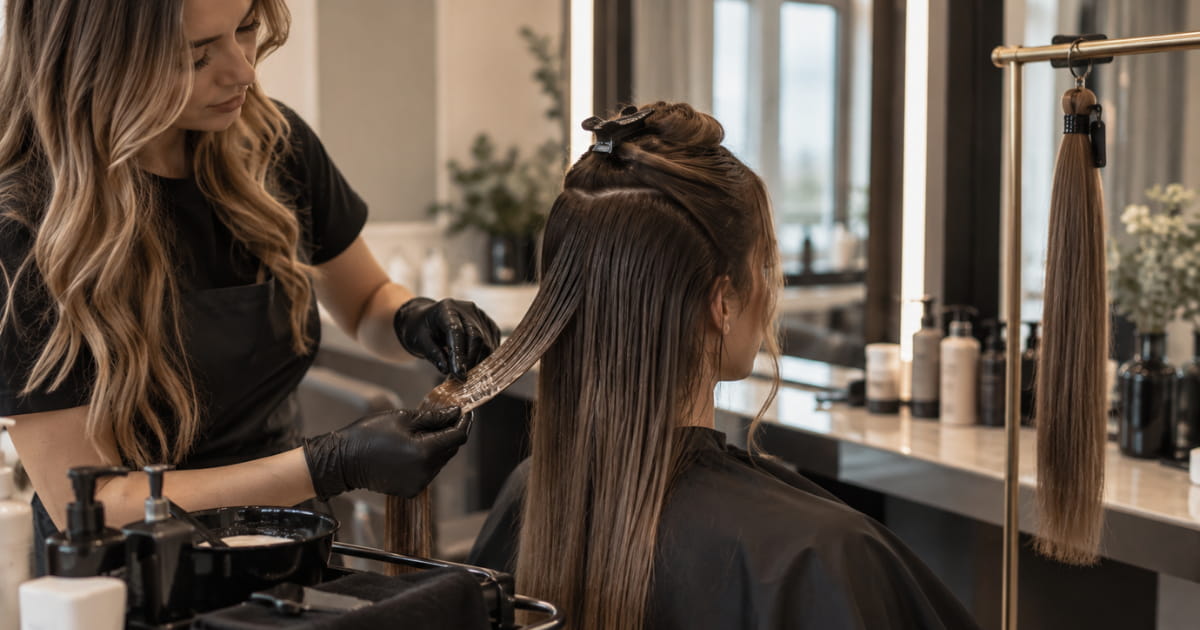
Ice Fusion vs K-Tip Hair Extensions: What’s Better for Fine Hair?

If you have fine hair, the right extension method matters more than the longest length or fullest look. Delicate strands need lightweight bonds, careful placement, realistic density, and a maintenance plan that does not create unnecessary tension at the roots.
So, when comparing Ice Fusion vs K-Tip hair extensions, which one is better for fine hair?
Ice Fusion is often the better starting point for fine hair because it uses small cold-applied bonds, does not require heat during installation, and allows the stylist to customize bond size, placement, and density around your natural hair. K-Tip extensions can still work for some clients, but they typically involve heat during installation and require careful bond sizing, placement, and enough natural strand strength.
At Bloom Studio Hair Extensions in Houston, the safest answer starts with consultation. Fine hair can look beautiful with extensions, but the plan must be built around your natural density, strand strength, scalp comfort, color match, lifestyle, and maintenance routine.
Ice Fusion vs K-Tip Hair Extensions: Quick Comparison for Fine Hair
Ice Fusion is usually best for fine, delicate, or lower-density hair that needs lightweight, discreet, no-heat bonds. K-Tips may be a better fit for clients who have enough natural density and strand strength to support keratin bonds installed with heat. Neither method is ideal for hair that is actively shedding, extremely fragile, or not strong enough to support added weight.
Are Ice Fusion Extensions Better Than K-Tips for Fine Hair?
Yes, Ice Fusion extensions are often better than K-Tips for fine hair when the goal is a lightweight, discreet, no-heat installation. The small strand-by-strand bonds can be customized around natural density, which helps reduce bulk and improve comfort.
That does not mean K-Tips are automatically wrong. K-Tip hair extensions can look beautiful when installed by an experienced specialist on the right candidate. The concern for delicate hair is that K-Tips usually require heat during application, and the bonds must be sized very carefully so they do not feel too heavy, firm, or visible.
For fine or lower-density hair, the better method is usually the one that meets these conditions:
- The bonds are small enough for the natural strand density.
- The amount of added hair does not overpower the roots.
- The placement stays discreet when the hair moves.
- The length and volume goals are realistic.
- The client can follow the maintenance and aftercare routine.
- Removal and reinstall are done professionally and on time.
This is why Bloom Studio Hair Extensions recommends starting with a personalized Hair Extension Consultation, especially if your hair is fine, thin, fragile, or previously damaged.
What Makes Fine Hair Different?
Fine hair does not always mean “not enough hair.” It means each natural strand has a smaller diameter. Some clients have fine hair with a lot of density, while others have finer strands with lower density or visible thinning.
That difference matters because extensions attach to natural hair. If too much extension hair is attached to too little natural hair, the result may feel heavy, create pulling, or become harder to maintain.
Fine hair usually needs:
- Smaller bonds
- Lighter weight per section
- More conservative density
- Careful placement around the hairline and crown
- Softer blending through the ends
- A realistic maintenance schedule
If you are unsure whether your hair can support extensions, read our guide on Can You Get Hair Extensions with Fine, Thin Hair?. It explains why fine hair needs a more customized plan before installation.
Why Ice Fusion Can Be a Strong Choice for Fine Hair
Ice Fusion Hair Extensions are applied using a specialized cold fusion adhesive/gel without heat. Instead of applying wide wefts or larger sections, the method works strand by strand with small bonds that can be customized to the client’s natural hair.
For fine-hair clients, that customization is the main advantage.
1. No heat during installation
Fine hair can be more sensitive to heat, chemical history, and daily styling stress. Ice Fusion does not use hot fusion tools during installation, which may help reduce heat-related stress during the application process.
2. Smaller bond control
Because Ice Fusion is applied strand by strand, the stylist can adjust the size, weight, and placement of the bonds. This is important because one bond size does not work for every client.
A client with fine but dense hair may be able to wear more volume. A client with fine and sparse hair may need a softer, more conservative plan.
3. More discreet placement
Fine hair can reveal bonds more easily, especially around the temples, crown, or hairline. Ice Fusion micro-bonds can be placed strategically so the result looks soft and natural when the hair moves.
For clients who wear ponytails, soft waves, or everyday blowouts, placement matters just as much as the method.
4. Lightweight everyday feel
Many fine-hair clients worry that extensions will feel heavy or tight. Ice Fusion can be a good option because the bonds are designed to be lightweight when professionally installed and properly maintained.
For more details about the method, visit Ice Fusion Hair Extension Installation.
Where K-Tip Hair Extensions Can Be Less Ideal for Fine Hair
K-Tip hair extensions are also a strand-by-strand method, but they usually use a keratin bond that is softened with heat and attached to small sections of natural hair.
They can work well for some hair types, but delicate or lower-density hair needs extra caution.
1. Heat is usually part of the process
The main difference is installation. K-Tip extensions typically use a heated tool to melt or soften the keratin bond. For strong, medium-density hair, this may not be a major concern. For fine or fragile hair, the stylist needs to be especially careful with heat, sectioning, and bond size.
2. Bond size can feel firmer
K-Tip bonds can be small, but they may feel firmer than cold-applied micro-bonds depending on the installation. On fine hair, even a small difference in bond size can affect comfort and visibility.
3. Over-density is a bigger risk
Fine-hair clients often want volume, but adding too much hair can make extensions harder to blend and maintain. If K-Tips are too dense, too long, or placed too close to delicate areas, they may feel heavy.
The issue is not only the method. It is the match between the method, the client’s natural hair, and the stylist’s plan.
Which Method Looks More Natural on Fine Hair?
Ice Fusion often looks more natural on fine hair because the bonds can be customized in smaller, lighter sections. A natural result depends on more than the attachment method, though.
The most natural-looking fine hair extensions usually come from:
- Precise color matching
- Texture matching
- Correct bond size
- Strategic placement
- Realistic length choice
- Soft blending through the ends
- Proper aftercare at home
If your natural hair is fine, jumping from shoulder-length hair to very long, thick extensions may not be the most realistic plan. A softer volume-focused result may look more believable and feel more comfortable.
You can also explore common questions on the Hair Extensions FAQs page before booking.
Which Method Is Safer for Fine Hair?
Ice Fusion is often the safer choice for fine hair when it is installed with lightweight bonds, proper sectioning, and realistic density. However, no extension method is automatically safe if the installation is too heavy, the maintenance is skipped, or the removal is done incorrectly.
Fine hair safety depends on five things:
- The natural hair must be strong enough to support the bonds.
- The extension weight must match the client’s density.
- The bonds must not be placed too close to sensitive areas.
- The client must brush, wash, dry, and sleep with extensions correctly.
- Reinstall or removal must happen at the right time.
Aftercare also matters. Brushing correctly, drying the roots fully, avoiding heavy products near the bonds, and following a professional Care Plan can help keep extensions more comfortable between appointments.
At Bloom Studio Hair Extensions, the consultation is used to decide whether your hair is a better fit for length, volume, or a more conservative transformation.
Ice Fusion vs K-Tips: Who Should Choose Ice Fusion?
Ice Fusion may be a better fit if you:
- Have fine, thin, or fragile hair
- Want discreet bonds
- Are worried about heat during installation
- Want natural movement
- Prefer a lightweight feel
- Need careful color matching
- Wear your hair in soft waves, ponytails, or everyday styles
- Want a consultation-first plan instead of guessing
It may also be a strong choice for Houston clients because humidity can make aftercare more important. Lightweight bonds, dry roots, regular brushing, and timely maintenance all help keep extensions more comfortable between appointments.
Who Might Still Consider K-Tips?
K-Tips may still work for clients who have enough natural density, healthy strand strength, and realistic expectations. They may be appropriate when installed by a stylist who is experienced with fine hair and understands how to customize bond size and placement.
The key is not choosing K-Tips because they are popular. The key is choosing them only if your natural hair can support them safely.
If you are comparing both methods, bring these questions to your consultation:
- Is my natural hair dense enough for K-Tips?
- Would Ice Fusion be lighter for my roots?
- How much length can my hair safely support?
- Will the bonds show when I wear my hair up?
- How often will I need maintenance or reinstall?
- What products should I avoid near the bonds?
Fine Hair Extensions in Houston
If you are looking for fine hair extensions in Houston, the best method should be chosen after seeing your natural hair in person. At Bloom Studio Hair Extensions, every Ice Fusion or K-Tip plan starts with a consultation to check natural density, strand strength, scalp comfort, color match, lifestyle, and styling habits.
This helps create a plan that is realistic for your hair instead of choosing a method based only on trends, photos, or online recommendations.
The Best Choice for Fine Hair
For most fine-hair clients comparing Ice Fusion vs K-Tip hair extensions, Ice Fusion is often the better starting point because it offers a lightweight, no-heat, strand-by-strand approach that can be customized around natural density.
K-Tips can work for some clients, but they require careful heat application, precise bond sizing, and enough natural hair strength to support the result.
The safest choice is not based on a trend. It is based on your hair.
At Bloom Studio Hair Extensions in Houston, your consultation helps determine the right method, length, density, color match, and maintenance plan before installation. If you want natural-looking hair extensions without guessing, start with a personalized Hair Extension Consultation and choose the method your hair can actually support.
Frequently Asked Questions
How do Ice Fusion and K-Tip extensions compare for fine hair?
Neither method is automatically better for every client with fine hair. Ice Fusion Hair Extensions use a specialized cold fusion adhesive/gel without heat, while K-Tips use heat to soften and shape a keratin-based bond during application. Suitability depends on natural density and condition, strand strength, attachment size, weight distribution, placement, maintenance, removal, and styling goals. A consultation is needed before choosing a method for fine hair.
Can K-Tip extensions work on fine hair?
Yes, K-Tip extensions can work on fine hair for some clients, but they are not the best fit for everyone. Fine hair needs careful sectioning, smaller bonds, realistic density, and professional removal to reduce unnecessary stress on the natural hair.
Do Ice Fusion or K-Tip extensions damage fine hair?
Any extension method can stress fine hair if it is too heavy, poorly placed, left in too long, or removed incorrectly. Ice Fusion may be gentler for some fine-hair clients because it uses small cold-applied bonds, but safety still depends on consultation, installation, maintenance, and professional removal.
How long do Ice Fusion and K-Tip extensions last on fine hair?
Longevity depends on natural hair growth, bond condition, aftercare, and the installation plan. Fine-hair clients usually need timely maintenance or reinstall appointments so the bonds do not grow down too far or create unnecessary tension at the roots.
What is the best hair extension method for fine or thin hair?
There is no single best hair extension method for every person with fine or thin hair. Ice Fusion Hair Extensions may be a strong option for some clients because they use small strand-by-strand bonds and a specialized cold fusion adhesive/gel without heat. Suitability depends on natural density and condition, strand strength, bond sizing, weight distribution, professional installation, timely maintenance, and careful removal. A consultation is needed to confirm whether the hair can support the planned length and volume.
What should I expect during a consultation for fine hair extensions?
During a consultation for fine hair, Bloom Studio Hair Extensions reviews natural density, strand strength, hair condition, scalp comfort, current length and color, desired volume, styling habits, and maintenance expectations. We then discuss a suitable amount of extension hair, bond sizing, placement, color matching, timing, and pricing. The consultation is used to confirm whether the natural hair can support the proposed plan; it does not guarantee candidacy or a specific result.